Electric Cars: The Basics
For those of you new to zero-emission electric driving, we recommend a read of the following articles:
What Is Regenerative Braking In Electric Cars: The Basics: The Complete Electric Car Buying Guide For India
Electric Cars: The Basics For those of you new to zero-emission electric driving, we recommend a read of the following articles: Sign up to the newsletter The Volvo S60…
Read More
The History Of Electric Cars and Vehicles: Are EVs A New Invention?
Electric Cars: The Basics For those of you new to zero-emission electric driving, we recommend a read of the following articles: Sign up to the newsletter The Volvo S60…
Read More
Different Types Of Electric Cars: The Complete Electric Car Buying Guide For India
Electric Cars: The Basics For those of you new to zero-emission electric driving, we recommend a read of the following articles: Sign up to the newsletter The Volvo S60…
Read More
Electric Cars and Vehicles: Pros, Cons And Myths: The Complete Electric Car Buying Guide For India
Electric Cars: The Basics For those of you new to zero-emission electric driving, we recommend a read of the following articles: Sign up to the newsletter The Volvo S60…
Read More
Electric Cars Range: WLTP: The Basics: The Complete Electric Car Buying Guide For India
Electric Cars: The Basics For those of you new to zero-emission electric driving, we recommend a read of the following articles: Sign up to the newsletter The Volvo S60…
Read MoreSign up to the newsletter
The Volvo S60 Recharge Plug-In Hybrid Saloon
Sweden has created its fair share of global brands, but none with a reputation as good as Volvo Cars, when it comes to passenger safety. Volvo cars is an automotive manufacturer based in Gothenburg, Sweden. The Volvo Group has a long history of success and was established in 1927. The Volvo electric vehicle (EV) current portfolio includes:
- All-electric Volvo C40 Recharge (BEV)
- All-electric Volvo EX90 (BEV)
- All-electric Volvo EX30 (BEV)
- All-electric Volvo ES90 (BEV)
- All-electric Volvo XC40 Recharge (BEV)
- Volvo XC40 Recharge Plug-in Hybrid (PHEV)
- Volvo XC60 Recharge Plug-in Hybrid (PHEV)
- Volvo XC90 Recharge Plug-in Hybrid (PHEV)
- Volvo S60 Recharge Plug-in Hybrid (PHEV)
- Volvo S90 Recharge Plug-in Hybrid (PHEV)
- Volvo V60 Recharge Plug-in Hybrid (PHEV)
- Volvo V90 Recharge Plug-in Hybrid (PHEV)
The Volvo S60 conventional petrol and diesel saloon variants have been available since 2000. As with other Volvo models, the company has also introduced the S60 as a lower tailpipe-emission plug-in hybrid electric vehicle (PHEV). In late 2021, the PHEV was upgraded.
The updated Volvo S60 Recharge PHEV has much to offer families and company-car drivers seeking practicality and lower motoring costs. The upgrade of the onboard EV battery has positioned this saloon electric car, as one of the few EVs capable of delivering a real-world emission-free electric range close to 80 km.
The Volvo S60 plug-in electric car has a 18.8 kWh onboard EV battery, with a claimed zero-emission electric range up to 90 km (WLTP certified). This is certainly impressive, given the average EV range of a PHEV (40 km).
However, the real-world EV range will be lower, impacted by a number of factors, to include: driving profile, speed, passenger load, weather, road condition and more. Assuming a 75 km emission-free electric range is more realistic, which still remains impressive and can be leveraged for city and motorway driving.
If your driving is predominantly motorway and long-distances, dependent on the internal combustion engine (ICE), it would be a challenge to truly leverage the benefits of zero-tailpipe emission electric driving. However, if the majority of your travel is shorter distances, then the e-mode will certainly prove to be useful in saving money.
Volvo claims a fuel economy up to 0.9 l/100km! But achieving anything close to this claimed figure, will require using the onboard electric motor, powered by the EV battery on a regular basis. As is the case with the real-world electric range, expect the real-world fuel economy to be lower than the manufacturer claimed figures.
Having said that, the using of the pure electric range will help deliver a far better fuel economy for the vehicle, compared to the conventional S60 petrol engine variant. In any case, both, the EV range and fuel economy of the upgraded Volvo S60 saloon PHEV position it as class-leading.
Equally impressive is the updated tailpipe emissions data. Volvo claims tailpipe emissions as low as 17g (CO2/km), benefiting the local air quality. The conventional petrol variant has tailpipe emissions up to 153g CO2/km.
Despite the updates, it is disappointing to note that the PHEV does not offer DC charging. The EV has a 3.6 kW onboard charger. The Volvo electric vehicle can be charged 0% to 100% via a dedicated EV charging station in 5 hours. We at e-zoomed recommend a ‘topping up’ approach to EV charging. This way, EV range is available to use and regular charging also improves the long-term maintenance of the onboard EV battery. Volvo offers a 8 years or 160,000 km warranty.
The all-wheel drive S60 plug-in electric saloon car combines the T8 powertrain with an electric motor. The EV can achieve 0-100 km/h in 4.6 seconds (455 hp). The top speed of the EV is 180 km/h.
Despite the placement of the onboard EV battery, the EV is practical. The S60 plug-in offers a 391 L boot and ample space, headroom and legroom for passengers. The interior has been finished to a high standard and offers leather free upholstery and recycled carpets.
It also offers a generous level of standard equipment, safety features and technology. These include: google built in, 360° camera, BLIS and cross traffic alert, keyless entry and keyless start, advanced air purifier, intelligent safety assistance and more. Bottom-line, electric driving is good for the environment and the wallet! The Volvo plug-in hybrid is not available in India.
| PROS | CONS |
|---|---|
| Impressive emission-free electric range | Not capable of DC charging |
| Good fuel economy | Onboard charger limited to 3.6 kW |
| Ultra-low tailpipe emissions (17g CO2/km) | Cheaper alternatives available |
Gallery


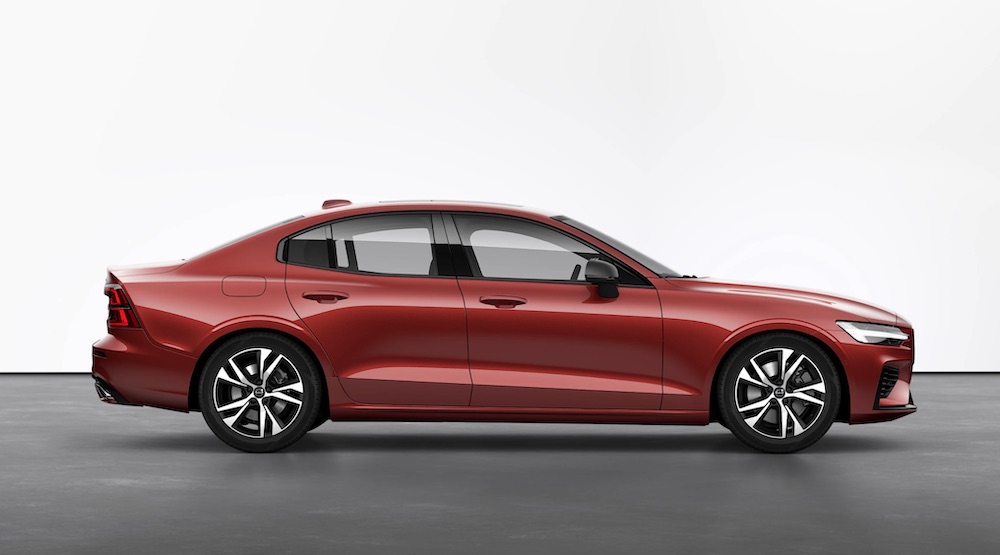
The Volvo S60 Recharge Plug-In Hybrid Saloon (credit: Volvo)
| At A Glance | |
|---|---|
| EV Type: | Plug-In Hybrid Electric Vehicle (PHEV) |
| Body Type: | Saloon |
| Engine: | Electric/ Petrol |
| Available In India: | No |
| Trims (1 Option) |
|---|
| Volvo S60 Recharge (Rs N/A) |
| EV Battery & Emissions | |
|---|---|
| EV Battery Type: | Lithium-ion |
| EV Battery Capacity: | Available in one battery size: 18.8 kWh |
| Charging: | DC charging not available. Onboard charger: 3.6 kW AC (0% – 100%: 5 hrs) |
| Charge Port: | Type 2 |
| EV Cable Type: | Type 2 |
| Tailpipe Emissions: | 17g (CO2/km) |
| Battery Warranty: | 8 years or 160,000 km |
| Charging Times (Overview) | |
|---|---|
| Slow charging AC (3 kW – 3.6 kW): | 6 – 12 hours (dependent on size of EV battery & SOC) |
| Fast charging AC (7 kW – 22 kW): | 3 – 8 hours (dependent on size of EV battery & SoC) |
| Rapid charging AC (43 kW): | 0-80%: 20 mins to 60 mins (dependent on size of EV battery & SoC) |
| Rapid charging DC (50 kW+): | 0-80%: 20 mins to 60 mins (dependent on size of EV battery & SoC) |
| Ultra rapid charging DC (150 kW+): | 0-80% : 20 mins to 40 mins (dependent on size of EV battery & SoC) |
| Tesla Supercharger (120 kW – 250 kW): | 0-80%: up to 25 mins (dependent on size of EV battery & SoC) |
- Note 1: SoC: state of charge
| Dimensions | |
|---|---|
| Height (mm): | 1437 |
| Width (mm): | 1850 |
| Length (mm): | 4761 |
| Wheelbase (mm): | 2872 |
| Turning Circle (m): | 11.4 |
| Boot Space (L): | 391 |
| Volvo S60 Plug-in Hybrid (T8 AWD plug-in hybrid) | |
|---|---|
| EV Battery Capacity: | 18.8 kWh |
| Pure Electric Range (WLTP): | 90 km |
| Electric Energy Consumption (kWh/100km): | 17.3 |
| Fuel Consumption (l/100km): | 0.9 |
| Charging: | DC charging not available. Onboard charger: 3.6 kW AC (0% – 100%: 5 hrs) |
| Top Speed: | 180 km/h |
| 0-100 km/h: | 4.6 seconds |
| Drive: | All-wheel drive (AWD) |
| Electric Motor (kW): | N/A |
| Horsepower (hp): | 455 |
| Torque (Nm): | 400 |
| Transmission: | Automatic |
| Seats: | 5 |
| Doors: | 4 |
| Gross Vehicle Weight (kg): | 2,500 |
| Colours: | 8 |
| NCAP Safety Rating: | Five-Star |
What Is A Heat Pump In Electric Cars?
| EV Heat Pump: The Basics | |
|---|---|
| What is a heat pump in electric cars? | In conventional internal combustion engine (ICE), petrol and diesel vehicles, the energy (waste heat) generated from the engine (powertrain), is captured to re-use for heating the interior cabin of the vehicle. However, in pure electric cars, the heat generated (waste heat) from the electric drive (electric motor, inverter, on-board AC charger) and the onboard high-voltage EV battery is not as much, as the heat generated in conventional cars, and cannot be re-used on its own to provide sufficient cabin heating (electric cars are more efficient than petrol/ diesel cars). Therefore in EVs, the sources for capturing heat, also includes the outside air i.e. it is a multi-source heat pump system. This captured heat is re-used for the onboard EV battery management and also for heating the cabin interior, increasing the electric car efficiency and reducing the need to draw energy from the onboard EV battery. In general, a lithium-ion EV battery is less energy efficient during colder months (similar to the laptop or smartphone battery). |
| How does a heat pump increase electric range in colder winter months? | Electric cars that do not incorporate an onboard heat pump, rely on the energy of the onboard EV battery for heating the interior cabin of the electric car, further impacting the available e-range. In contrast, EVs with a heat pump, do not rely on the onboard EV battery to heat the cabin. Instead, the heat pump sources heat from multiple sources and releases energy-efficient heating into the cabin. Put another way, an electric car with a heat pump does not place any demand on the onboard EV battery for heating the interior cabin. There is ample real-world evidence to prove that electric cars with a heat pump offer longer electric range in winter months, compared to electric cars that do not incorporate a heat pump. The average improvement in range is between 10% to 20%. |
| How does a heat pump work in an electric car? | Step 1: naturally heated antifreeze is channelled into the heat pump evaporator, where the heat is transferred to the coolant circulating in the unit. The evaporator converts the coolant into gas (evaporation). Step 2: the gas is sucked into a compressor to increase the pressure of the gas. When air is compressed it increases its temperature. The gas temperature is increased to 80° C. Step 3: the compressed gas is transferred to a condenser, where the heat is transferred to water in the condenser. Step 4: the heat is then circulated to the interior cabin, while the gas is converted into liquid form, and is transferred back to the heat pump evaporator via an expansion valve. The cycle is then repeated. |
| Is a heat pump used only for heating? | No. A heat pump can also be used for cooling. As an example, the Audi Q7 EV uses the onboard heat pump for heating and cooling. |
| Does a heat pump come as standard in EVs? | Though some manufacturers offer the heat pump as standard, most offer it as an optional extra. We recommend purchasing the option. |
| Can a heat pump be installed in an electric car post delivery? | Usually it is not possible, given the complexity of installing a heat pump. So always order it at the time of purchase. |
| Are all heat pumps in electric cars the same? | No. There is a difference in technology, approach and efficiency achieved for different manufacturers. As an example, Hyundai and Kia claim to have one of the most efficient heat pumps, given the ability of their technology to dynamically choose the most appropriate heat source at a given moment. Hyundai claims the heat pump incorporated in the all-electric Hyundai Kona can improve the winter electric range up to 18%, significantly higher than the average improvement (10%). |
| Are there any other advantages offered by a heat pump in colder months? | Yes, you can pre-heat the electric vehicle (EV) via your mobile app before you commence your journey. This way you can have a toasty warm interior cabin on a cold winter day! |
While e-zoomed uses reasonable efforts to provide accurate and up-to-date information, some of the information provided is gathered from third parties and has not been independently verified by e-zoomed. While the information from the third party sources is believed to be reliable, no warranty, express or implied, is made by e-zoomed regarding the accuracy, adequacy, completeness, legality, reliability or usefulness of any information. This disclaimer applies to both isolated and aggregate uses of this information.
Related articles

The Volvo S90 Recharge Plug-In Hybrid (Saloon): The Complete Electric Car Buying Guide For India
Electric Cars: The Basics For those of you new to zero-emission electric driving, we recommend a read of the following articles: Sign up to the newsletter The Volvo S60…
Read More
The All-Electric Genesis G80 EV (Saloon): The Complete Electric Car Buying Guide For India
Electric Cars: The Basics For those of you new to zero-emission electric driving, we recommend a read of the following articles: Sign up to the newsletter The Volvo S60…
Read More
The All-Electric BMW i5 (Saloon): The Complete Electric Car Buying Guide For India
Electric Cars: The Basics For those of you new to zero-emission electric driving, we recommend a read of the following articles: Sign up to the newsletter The Volvo S60…
Read More
The All-Electric BYD SEAL (Saloon): The Complete Electric Car Buying Guide For India
Electric Cars: The Basics For those of you new to zero-emission electric driving, we recommend a read of the following articles: Sign up to the newsletter The Volvo S60…
Read More
The Volkswagen ID.7 Electric (Saloon): The Complete Electric Car Buying Guide For India
Electric Cars: The Basics For those of you new to zero-emission electric driving, we recommend a read of the following articles: Sign up to the newsletter The Volvo S60…
Read More