

Electric Cars: The Basics
For those of you new to zero-emission electric driving, we recommend a read of the following articles:
What Is Regenerative Braking In Electric Cars: The Basics: The Complete Electric Car Buying Guide For India
Electric Cars: The Basics For those of you new to zero-emission electric driving, we recommend a read of the following articles: Sign up to the newsletter The Mazda CX-80…
Read More
The History Of Electric Cars and Vehicles: Are EVs A New Invention?
Electric Cars: The Basics For those of you new to zero-emission electric driving, we recommend a read of the following articles: Sign up to the newsletter The Mazda CX-80…
Read More
Different Types Of Electric Cars: The Complete Electric Car Buying Guide For India
Electric Cars: The Basics For those of you new to zero-emission electric driving, we recommend a read of the following articles: Sign up to the newsletter The Mazda CX-80…
Read More
Electric Cars and Vehicles: Pros, Cons And Myths: The Complete Electric Car Buying Guide For India
Electric Cars: The Basics For those of you new to zero-emission electric driving, we recommend a read of the following articles: Sign up to the newsletter The Mazda CX-80…
Read More
Electric Cars Range: WLTP: The Basics: The Complete Electric Car Buying Guide For India
Electric Cars: The Basics For those of you new to zero-emission electric driving, we recommend a read of the following articles: Sign up to the newsletter The Mazda CX-80…
Read MoreSign up to the newsletter
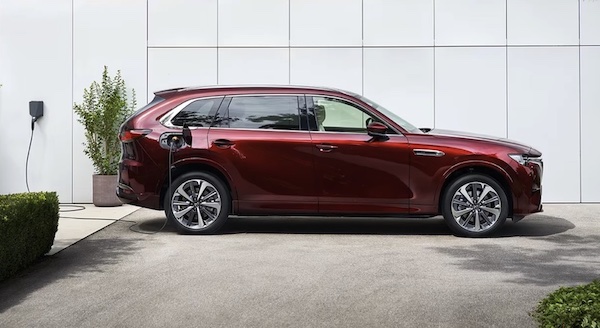
The Mazda CX-80 PHEV SUV
The Mazda Motor Corporation, more commonly known simply as Mazda, is a leading Japanese automotive manufacturer, with business activities across a number of key international markets. Mazda was founded in 1920, initially as a cork-making factory (Toyo Cork Kogyo Co, Ltd.). The company started manufacturing vehicles in 1931. The ‘Mazda-go’, a tricycle truck, was the first vehicle to be manufactured by the company. Mazda derives its name from ‘Ahura Mazda’, the God of harmony, intelligence and wisdom.
Mazda has conducted research on alternative fuel vehicles for many decades. The company has had a particular focus on hydrogen-powered vehicles. The Mazda electric vehicle (EV) portfolio includes both, battery-electric vehicle (BEV) and plug-in hybrid electric vehicle (PHEV) models:
- All-electric Mazda MX-30 (BEV)
- Mazda CX-60 plug-in hybrid (PHEV)
- Mazda CX-80 plug-in hybrid (PHEV)
- Mazda MX-30 R-EV plug-in hybrid (PHEV)
For those keen to migrate to electric vehicles (EVs), but undecided between an all-electric car (pure electric car) or a plug-in hybrid electric car, we at e-zoomed encourage opting for an all-electric car. The availability of pure electric cars across all segments and budgets is excellent, offering style, technology, versatility, practicality, fun and more than adequate real-world zero-tailpipe emission electric range. Though there are many reasons to chose a battery-electric vehicle (BEV) over a plug-in hybrid electric vehicle (PHEV), the two key reasons are: lower life-cycle costs and lower life-cycle environmental impact (emissions).
Contrary to what is usually suggested, BEVs, also known as all-electric cars/ pure electric cars, are cheaper to own, operate, charge (refill) and maintain over the life of the electric vehicle, compared to plug-in hybrid electric vehicles (PHEVs), and conventional internal combustion engine (ICE) petrol and diesel cars. In stark contrast, conventional petrol and diesel vehicles have the highest cost of ownership of a vehicle.
Moreover, on a life-cycle emission basis, BEVs have far lower emissions compared to PHEVs or conventional petrol and diesel vehicles. BEVs life-cycle emissions are potentially 50% lower compared to conventional petrol or diesel vehicles! And do keep in mind a BEV does not have a tailpipe i.e. zero-tailpipe emissions (improving local air quality). So owning a BEV is both, good for the environment and the household/ business wallet!
Of course, for those still keen on a plug-in electric car, the choice and availability has also increased significantly over the recent years, with PHEVs capable of delivering practical real-world zero-tailpipe emission electric range. The earlier generation of PHEVs had a small (less than 10 kWh) onboard EV battery, with a real-world range less than 30 km. Though the claimed WLTP electric range (60 km) for the Mazda CX-80 PHEV is an improvement from the earlier PHEVs, it is a marginal improvement.
The plug-in hybrid CX-80 has a 17.8 kWh (355V) onboard lithium-ion EV battery. The Mazda sibling, the CX-60 PHEV also has a 17.8 kWh battery. In fact, there is much more in common in the underpinnings between the Mazda CX-80 and Mazda CX-60, to include the powertrains.
Adjusting for real-world driving conditions, expect an electric range up to 50 km on a full charge for the CX-80 PHEV. Adequate, but certainly not inspiring. The manufacturer should have considered a slightly larger onboard EV battery to achieve a longer e-range. For those new to electric cars, a number of factors can impact the manufacturers published WLTP e-range.
Some of these include: driving profile, road conditions, weather, temperature, payload, passengers etc. As an example, the heavier the vehicle, the shorter the electric range. A practical tip is to make certain the boot is clear of items that do not need to be carried!
The Mazda CX-80 PHEV does not offer DC charging capability, but this is the case with the majority of plug-in hybrids, given the small size of the EV battery. The EV incorporates a single-phase onboard AC charger. The EV can be charged from 0%-100% in 2 hours and 20 minutes via a dedicated smart residential EV charger. We encourage the use of a solar compatible smart EV charger, like myenergi zappi, along with an on-site PV system and energy storage system.
The Mazda CX-80 was revealed in April 2024. The EV interior cabin is based on the Japanese philosophy ‘Ma’, to create a sense of a calm and peaceful journey! In terms of size, the mid-sized CX-80 PHEV is larger than the five-seater CX-60 PHEV. The CX-80 is 4.9m long and 1.7m tall. In comparison, the CX-60 is 4.7m long and 1.6m tall. A better comparison is with the all-electric best-selling seven-seater Kia EV9. The EV9 is 5m in length and 1.7m in height! Despite the three-rows, the CX-80 PHEV offers decent legroom and headroom, to include, the 3rd row!
The CX-80 PHEV is available in both, a 6-seat and 7-seat configuration (the third-row has a maximum of 2 seats). The PHEV has up to 687 L in boot space. If the second and third row seats are folded, then the maximum available cargo space increases to 1,971 L. The interior is appointed to a reasonable quality. The exterior styling of the CX-80 is also similar to the CX-60. Mazda has used its award winning Kodo – Soul of Motion design language for the PHEV. We believe it works well!
The EV offers the following safety features as standard on all variants: blind spot monitoring with rear cross traffic alert and vehicle exit warning, driver monitoring, road keep assist, blind spot assist, oncoming vehicle collision avoidance assist, front cross traffic alert, hill descent control, lane-keep assist system with lane departure warning system and traffic sign recognition. Also as standard are: 12.3” colour centre display and wireless Apple CarPlay & Android Auto. The panoramic sunroof only comes as standard on the more expensive trims! The PHEV is yet to receive the Euro NCAP Rating.
The all-wheel drive (AWD) 2.5 e-SKYACTIV CX-80 PHEV incorporates a four-cylinder 2.5-litre engine. The EV can achieve 0-100 km/h in 6.8 seconds (maximum power: 327 ps/ torque: 500 Nm). The top speed of the PHEV is 195 km/h. The EV incorporates the Mazda Mi-DRIVE (Intelligent Drive Select System). Some of these modes include: Sport, Off-Road, Towing and EV mode. We encourage using the EV mode as often as possible! The manufacturer claims a 1.61 L/100 km fuel economy.
In the real-world to get anywhere close to the claimed mpg, the PHEV will need to be driven as much as possible on electric mode. Do keep in mind that if the PHEV is driven primarily using the onboard internal combustion engine (ICE) then the real-world fuel economy will be similar to the conventional petrol variant. So best to keep the onboard battery charged on a regular basis, so that the full benefits of a PHEV can be leveraged.
The Mazda CX-80 plug-in electric SUV has tailpipe emission up to 36g CO2/km. Not class-leading but certainly lower than the conventional internal combustion engine (ICE) variant. Bottom-line, electric driving is good for the environment and the wallet!
| PROS | CONS |
|---|---|
| An affordable PHEV | Limited real-world electric range compared to some competitors |
| All-wheel drive (AWD) as standard | Tailpipe emissions not as low as other class-leading PHEVs |
| Up to 7 seats (three-rows) | Top trims expensive |
Gallery
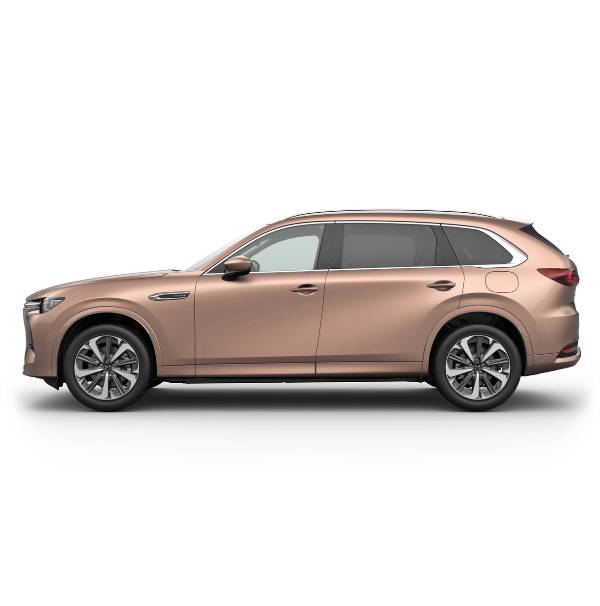
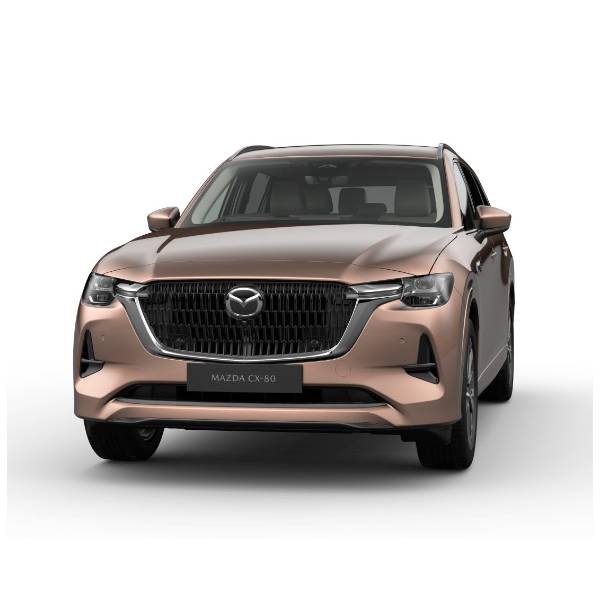
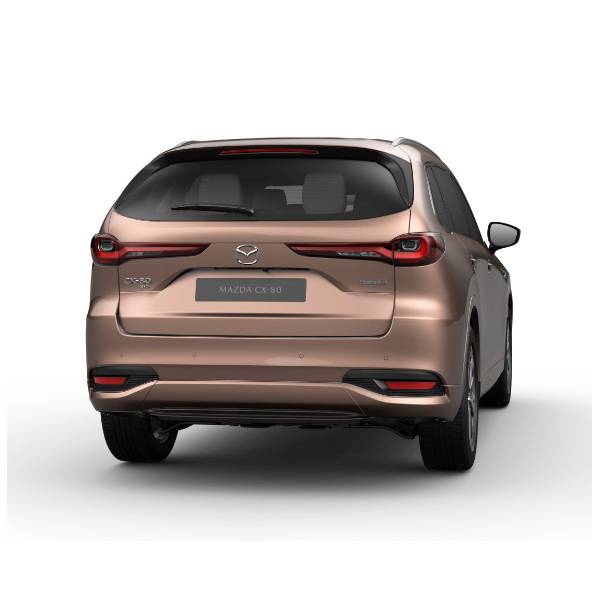
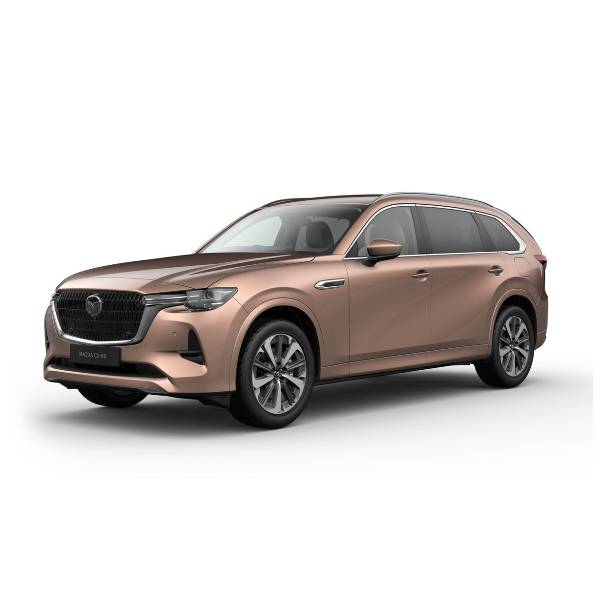
The Mazda CX-80 Plug-In Hybrid SUV (credit: Mazda)
| At A Glance | |
|---|---|
| EV Type: | Plug-In Hybrid Electric Vehicle (PHEV) |
| Body Type: | SUV |
| Engine: | Petrol/ Electric |
| Available In India: | No |
| Variants (1 Option) |
|---|
| Mazda CX-80 PHEV (from ₹ N/A) |
| EV Battery & Emissions | |
|---|---|
| EV Battery Type: | Lithium-ion |
| EV Battery Capacity: | Available in one battery size: 17.8 kWh (177.5 kg) |
| Charging: | DC charging not available. Onboard AC charger: 7.2 kW AC (0%-100%: 2 hrs 20 mins) |
| Charge Port: | Type 2 |
| EV Cable Type: | Type 2 |
| Tailpipe Emissions: | 35 – 36g (CO2/km) |
| Battery Warranty: | 8 years or 160,000 km |
| Charging Times (Overview) | |
|---|---|
| Slow charging AC (3 kW – 3.6 kW): | 6 – 12 hours (dependent on size of EV battery & SOC) |
| Fast charging AC (7 kW – 22 kW): | 3 – 8 hours (dependent on size of EV battery & SoC) |
| Rapid charging AC (43 kW): | 0-80%: 20 mins to 60 mins (dependent on size of EV battery & SoC) |
| Rapid charging DC (50 kW+): | 0-80%: 20 mins to 60 mins (dependent on size of EV battery & SoC) |
| Ultra rapid charging DC (150 kW+): | 0-80% : 20 mins to 40 mins (dependent on size of EV battery & SoC) |
| Tesla Supercharger (120 kW – 250 kW): | 0-80%: up to 25 mins (dependent on size of EV battery & SoC) |
- Note 1: SoC: state of charge
| Dimensions | |
|---|---|
| Height (mm): | 1710 |
| Width (mm): | 1890 |
| Length (mm): | 4995 |
| Wheelbase (mm): | 3120 |
| Turning Circle (m): | 12.4 |
| Boot Space (L): | 258 – 687 |
| Frunk (L): | N/A |
| 2.5 e-SKYACTIV PHEV | |
|---|---|
| EV Battery Capacity: | 17.8 kWh |
| Pure Electric Range (WLTP): | 60 km |
| Electric Energy Consumption (km/kWh): | N/A |
| Fuel Consumption (L/100 km): | 1.61 |
| Charging: | DC charging not available. Onboard AC charger: 7.2 kW AC (0%-100%: 2 hrs 20 mins) |
| Top Speed: | 195 km/h |
| 0-100 km/h: | 6.8 seconds |
| Drive: | All-wheel drive (AWD) |
| Electric Motor (kW): | 241 |
| Horsepower (ps): | 327 |
| Torque (Nm): | 500 |
| Transmission: | Automatic |
| Seats: | Up to 7 |
| Doors: | 5 |
| Kerb Weight (kg): | 2,165 / 2,216 |
| Towing Capacity (Braked/Unbraked)/ (kg): | 2,500 |
| Colours: | 9 |
| Euro NCAP Safety Rating: | N/A |
Buying EV Cables: Top 3 Tips
When it comes to electric car charging cables, an astute electric car owner will focus on quality and performance over cheapest price. We encourage all EV owners to adopt a similar approach!
| EV Cables: Top 3 Tips | |
|---|---|
| Never buy cheap: | Not all EV charging cables are the same. It is simply false economy to try and save a few Rupees on buying a cheaper cable, when in all probability the EV you own is worth over Rs 50 Lakhs! Nor are we suggesting you buy the most expensive. There is always a balance between price and quality, and electric car charging cables are no different. The last thing you need is to have the EV charging cable stop working when you most need it. EV cables on the e-zoomed Electric Living Shop are made from TPU (Thermoplastic Polyurethane), a higher quality material that is extremely flexible, durable and smooth to touch. |
| The shortest length is never the best choice: | A number of customers seek the shortest length (2m EV charging cable) because it is the cheapest. However a 2m EV cable is limited in practicality and usually not a good long-term investment. Most charging destinations (home or public) require an EV charging cable that is longer than 2m. In our experience, most customers buy EV charging cables between 5m and 25m. We recommend at least a 5m charging cable. It is long enough to meet most charging needs, but compact enough to be carried and put away easily! Of course, a number of customers need even longer EV cables. |
| A lower technical specification EV charging cable Is never the best choice: | As above, a number of electric car owners seek to buy a 16 amp (single-phase) EV charging cable, instead of a 32 amp (single-phase) EV charging cable. The reason is simple. The 16 amp is marginally cheaper! However, a 16 amp charging cable charges at 3.6 kW, a much slower rate to a 32 amp EV charging cable that charges at 7.2 kW. An ampere is the unit for measuring electricity. The accepted standard unit used for measuring how fast an electric current flows is an example of an ampere. The reason why customers in India buy a single-phase EV cable, is because most homes in India are powered by single-phase power supply. Also important to asses is the IP Rating for the EV cable. Not all EV cables have the same IP Rating. Of course, warranty is also important. Most EV cables are sold with a warranty of at least 2 years! |
While e-zoomed uses reasonable efforts to provide accurate and up-to-date information, some of the information provided is gathered from third parties and has not been independently verified by e-zoomed. While the information from the third party sources is believed to be reliable, no warranty, express or implied, is made by e-zoomed regarding the accuracy, adequacy, completeness, legality, reliability or usefulness of any information. This disclaimer applies to both isolated and aggregate uses of this information.
Related articles

The Lexus NX Plug-In Hybrid (SUV): The Complete Electric Car Buying Guide For India
Electric Cars: The Basics For those of you new to zero-emission electric driving, we recommend a read of the following articles: Sign up to the newsletter The Mazda CX-80…
Read More
The Citroën C5 X Plug-In Hybrid (SUV): The Complete Electric Car Buying Guide For India
Electric Cars: The Basics For those of you new to zero-emission electric driving, we recommend a read of the following articles: Sign up to the newsletter The Mazda CX-80…
Read More
The MG HS Plug-In Hybrid (SUV): The Complete Electric Car Buying Guide For India
Electric Cars: The Basics For those of you new to zero-emission electric driving, we recommend a read of the following articles: Sign up to the newsletter The Mazda CX-80…
Read More
The BYD SEAL U DM-i Plug-In Hybrid (SUV): The Complete Electric Car Buying Guide For India
Electric Cars: The Basics For those of you new to zero-emission electric driving, we recommend a read of the following articles: Sign up to the newsletter The Mazda CX-80…
Read More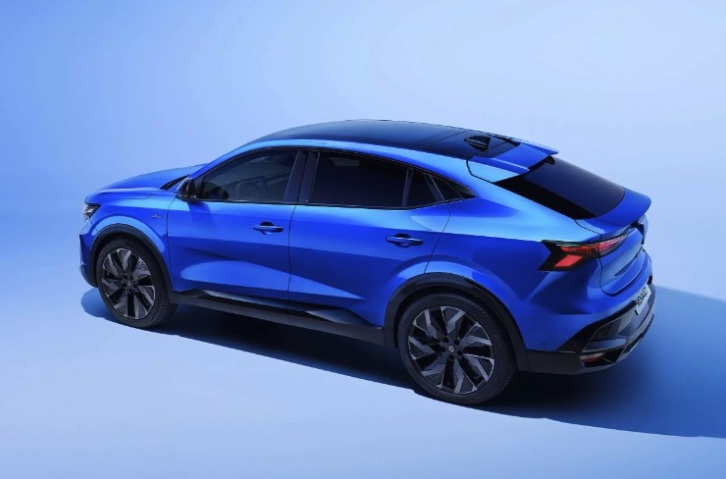
The Renault Rafale E-Tech Plug-In Hybrid (SUV): The Complete Electric Car Buying Guide For India
Electric Cars: The Basics For those of you new to zero-emission electric driving, we recommend a read of the following articles: Sign up to the newsletter The Mazda CX-80…
Read More
The Lexus RX Plug-In Hybrid (SUV): The Complete Electric Car Buying Guide For India
Electric Cars: The Basics For those of you new to zero-emission electric driving, we recommend a read of the following articles: Sign up to the newsletter The Mazda CX-80…
Read More