

Electric Cars: The Basics
For those of you new to zero-emission electric driving, we recommend a read of the following articles:
What Is Regenerative Braking In Electric Cars: The Basics: The Complete Electric Car Buying Guide For India
Electric Cars: The Basics For those of you new to zero-emission electric driving, we recommend a read of the following articles: Sign up to the newsletter The All-Electric Renault…
Read More
The History Of Electric Cars and Vehicles: Are EVs A New Invention?
Electric Cars: The Basics For those of you new to zero-emission electric driving, we recommend a read of the following articles: Sign up to the newsletter The All-Electric Renault…
Read More
Different Types Of Electric Cars: The Complete Electric Car Buying Guide For India
Electric Cars: The Basics For those of you new to zero-emission electric driving, we recommend a read of the following articles: Sign up to the newsletter The All-Electric Renault…
Read More
Electric Cars and Vehicles: Pros, Cons And Myths: The Complete Electric Car Buying Guide For India
Electric Cars: The Basics For those of you new to zero-emission electric driving, we recommend a read of the following articles: Sign up to the newsletter The All-Electric Renault…
Read More
Electric Cars Range: WLTP: The Basics: The Complete Electric Car Buying Guide For India
Electric Cars: The Basics For those of you new to zero-emission electric driving, we recommend a read of the following articles: Sign up to the newsletter The All-Electric Renault…
Read MoreSign up to the newsletter
The All-Electric Renault 4 E-Tech SUV
Groupe Renault (Renault Group/ Renault S.A.), is a leading player in the global automotive sector. The company was established in 1899 and has over the course of its history, manufactured varied vehicles, to include: trucks, tractors, buses and even tanks! Renault has been part of the global Renault-Nissan-Mitsubishi Alliance since 1999 (previously, Renault-Nissan Alliance). The partnership makes the partnership the 3rd largest automotive group in the world after Volkswagen and Toyota. Renault offers both, battery-electric vehicles (BEVs), and plug-in hybrid electric vehicles (PHEVs) for passenger cars and commercial electric vehicles. The portfolio includes:
- All-electric Renault TWIZY (BEV)
- All-electric Renault ZOE E-TECH (BEV)
- All-electric Renault ZOE Van E-TECH (BEV)
- All-electric Renault Megane E-TECH (BEV)
- All-electric Renault Scenic E-TECH (BEV)
- All-electric Renault 4 E-TECH (BEV)
- All-electric Renault 5 E-TECH (BEV)
- All-electric Renault Kangoo E-TECH (BEV)
- All-electric Renault Master E-TECH (BEV)
- Renault Rafale E-Tech Plug-In Hybrid (PHEV)
- Renault Captur E-TECH Plug-In Hybrid (PHEV)
- Renault Megane E-TECH Plug-In Hybrid (PHEV)
- Renault Megane Sport Tourer E-TECH Plug-In Hybrid (PHEV)
The all-electric Renault 4 is another example of an automotive manufacturer (OEM) resurrecting a car model from the archives of automotive history for the new age of electric driving. Other examples are: the all-electric Renault 5, the all-electric Ford Capri, the all-electric Volkswagen ID. Buzz, the all-electric Fiat 500e and many more! We can expect this trend to continue as automotive manufacturers seek to leverage the brand cachet of previous best-selling car models to gain market leadership in the fast evolving electric car industry. The Renault 4 is only available as a battery-electric vehicle (BEV).
The first-generation Renault 4 was launched in 1961. By 1966 a million front-wheel drive (FWD) Renault 4 hatchbacks had been manufactured. In fact, the Renault 4 was one of the first hatchbacks to be launched. In total 8 million were built across four continents over a 33 year period. Production ended in 1994.
The all-electric Renault 4 has been positioned as a compact crossover SUV. A trend that continues to gain momentum as electric car manufacturers capitalise on the popularity of this segment. The EV was unveiled at the 2024 Paris Motor Show. In terms of dimensions, the five-door Renault 4 (B Segment) is 4.14m long and 1.57m tall (1.79m wide). The Renault 4 offers a 420 L boot (up to 1,405 with rear seats folded down). This size is certainly class-leading and the wide aperture/ low loading lip does make access to the boot easy. The boot also includes a 35 L underfloor area to store the EV charging cable. The electric tailgate is hands-free and can be opened with a foot gesture. The BEV does not have a frunk.
The Renault 4 has been developed on the EV-native AmpR Small platform, also used by the all-electric Renault 5 (3.92m long and 1.49m tall). The Renault 4, which is larger than the Renault 5, shares 68% of its components with the Renault 5. Yes, the Renault 4 is more practical than its sibling, the Renault 5.
In comparison, the all-electric Hyundai INSTER is 3.82m long and 1.57m tall (1.61m wide). The INSTER offers a 238 L boot. The all-electric Citroën ë-C3 is 4.01m long and 1.57m tall (1.81m wide). The ë-C3 has 310 L boot (up to 1,188 L with rear seats folded down). And the all-electric Jeep Avenger is 4.08m long and 1.53m tall (1.78m wide). The Avenger has 355 L boot.
We are e-zoomed encourage drivers to opt for smaller cars, in particular, zero-tailpipe emission electric cars. Best choice for improving local air quality and lowering your impact on the environment. The smaller the vehicle, the lower the life-cycle emissions from the vehicle! In general, battery-electric vehicles (BEVs) reduce life-cycle emissions by up to 70% compared to internal combustion engine (ICE) petrol and diesel cars!
The five-seat Renault 4 offers practical interior space, along with practical internal storage (23.3 L). Having said that, for longer drivers, 3 adults seated on the rear seats would be a tight squeeze given the limited legroom for passengers seated in the rear. The EV does benefit from a flat floor. Renault offers a number of colour and design options to further personalise the interior, to include a baguette holder. Now, that’s French! Also on offer are 3D printed accessories. The Renault 4 interior cockpit is the same as Renault 5.
The EV is available in two roof options: an electric ‘plein sud’ canvas roof or a fixed roof with roof bars. We like them both! The sunroof can be opened via a one touch button or voice command. The canvas opens up to 92cm. As is now the trend with manufacturers, both circularity and recycling are a core part of development. 26.4% of the materials are from the circular economy, seat fabric is made from 100% recycled fibres and at the end of the vehicle life, the Renault 4 has a 88.6% overall recyclability. The family electric car is assembled at the Renault Maubeuge factory in France.
The Renault 4 BEV is available in two EV battery sizes: 40 kWh (237 kg / 400V) and 52 kWh (297 kg / 400V). According to Renault, the entry-level 40 kWh variant has a 308 km (WLTP) e-range (km per kWh: 7.70) and the 52 kWh variant has an electric range up to 409 km (WLTP) on a full charge (km per kWh: 7.86). Even adjusting for real-world driving conditions, the EV should be able to deliver up to 265 km for the 40 kWh, and up to 350 km for the 52 kWh battery.
A number of factors impact e-range, to include: driving style, speed, road surface, vehicle weight, weather, temperature, terrain, tyre size, regenerative braking profile and more! In comparison, the Hyundai INSTER (49 kWh battery) offers up to 355 km (WLTP) and the Citroën ë-C3 (44 kWh battery) up to 320 km (WLTP).
It is interesting to note that many EV owners are now reporting a real-world electric range the same as the published WLTP range. This is certainly good to note as it demonstrates that manufacturers continue to make progress on increasing efficiency of the electric vehicle and improvements in battery performance. In any case, the Renault 4 offers ample practical e-range, further enhanced by an onboard heat pump (as standard). A heat pump increases the efficiency of the EV i.e. reduces energy consumption and increases the electric range.
The Renault 4 e-SUV incorporates a 11 kW AC (three-phase) onboard AC charger as standard. Homes powered by single-phase AC power supply, EV charging will be limited to 7.4 kW AC (single-phase). For those with access to three-phase (11kW AC) EV charging (home, workplace or public charging), the 52 kWh EV battery can be charged 15%-80% in 3 hrs 13 mins. The 40 kWh will take up to 2 hrs 37 mins.
Single-phase EV charging will take longer: 15%-80%: 5 hrs 11 mins for the 52 kWh and up to 3 hrs 55 mins for the 40 kWh. The EV incorporates a 100 kW DC rapid charging as standard: 15%-80%: 30 minutes. Not class-leading, but adequate, given the size of the EV battery.
We at e-zoomed encourage using a dedicated smart solar compatible EV charger for home charging. e-zoomed offers a wide range of high quality residential EV chargers (supply and installation). We at e-zoomed also encourage EV owners to install on-site (home or business) solar PV and battery storage. It is a fantastic way to leverage the potential for lower cost of ownership of an electric car, and also achieve ‘well-to-wheel’ zero-tailpipe emissions.
Bi-directional EV charging (Vehicle-to-load (V2L)) is standard on all variants. V2L charging is a bidirectional functionality allowing an electric vehicle (EV) to use its onboard high-voltage EV battery to charge or power devices/ appliances. It is also sometimes referred to as Vehicle-to-Device (V2D). Depending on the type of device/ appliance that needs to be charged or operated, V2L can be used while the EV is moving or parked. As an example, a laptop can be charged or used when an EV is parked or moving, while a lawn mower can only be charged or used when the EV is parked.
In terms of safety features and driving aids, the BEV offers up to 26 advance driving-assistance systems. Some of these include: reversing camera, lane keeping assist, lane departure warning, safe following distance warning, driver attention alert, hill start assist, automatic urban and inter-urban emergency braking (with detection of cars, pedestrians and cyclists), traffic sign recognition with speed alert, cruise control and speed limiter, hands-free parking, blind spot warning and more.
The EV has been awarded a four-star Euro NCAP Safety Rating. Other technology/ equipment on offer, includes: 7″-10″ driver display, openR link 10″, wireless smartphone charging (compatible with Apple CarPlay and Android Auto) and more. The EV also features ‘reno’, the official Renault avatar to assist the EV owner get the most from the BEV! Bottom-line, the BEV offers a host of technology and equipment.
In terms of exterior styling, Renault has tried to capture the retro look, albeit with a modern twist. The company calls it a ‘retro-futuristic reinvention’. An example is the single-piece illuminated front grille which has been inspired by the original Renault 4. It sports an illuminated logo for the first time. The rear lights also have been inspired by the original hatchback’s three-part lights. Renault has certainly paid faithful homage to the original Renault 4.
Having said that, the Renault 5 exterior styling is far more captivating compared to the Renault 4 boxy styling. The BEV is available in 6 colour options. Our favourite is the cumulus blue! Also on offer are: single-tone, two-tone black roof paint and black bonnet. The manufacturer offers a number of customisable options for the exterior.
The Renault 4 is only available as a front-wheel drive (FWD), with a single-motor powertrain i.e. the electric motor drives the front wheels. The entry-level EV40 120hp electric car can achieve 0-100 km/h in 9.2 seconds (maximum power: 120 HP/ torque: 225 Nm). The EV52 150hp variant can achieve 0-100 km/h in 8.2 seconds (maximum power: 150 HP/ torque: 290 Nm). The top speed of the family electric car is 150 km/h.
The EV incorporates one-pedal driving (not standard on all variants) and 4 levels of regenerative braking. Regen levels can be adjusted via the paddles on the steering wheel. The EV also offers battery temperature preconditioning, but again, not standard on all variants. For the driver there is good all-round visibility. Having said that, the headrests in the rear do limit the rear-view. We like the physical climate controls in the Renault 4. So much easier to use while driving compared to navigating a touchscreen!
Bottom-line, electric driving is good for the environment and the wallet!
| PROS | CONS |
|---|---|
| Value for money: good level of technology and equipment as standard | DC charging limited to 100 kW DC |
| 11 KW AC onboard charger/ heat pump/ V2L as standard | Exterior styling not as captivating as the Renault 5 |
| Good boot space and practical internal storage | NCAP Rating four-star |
Gallery
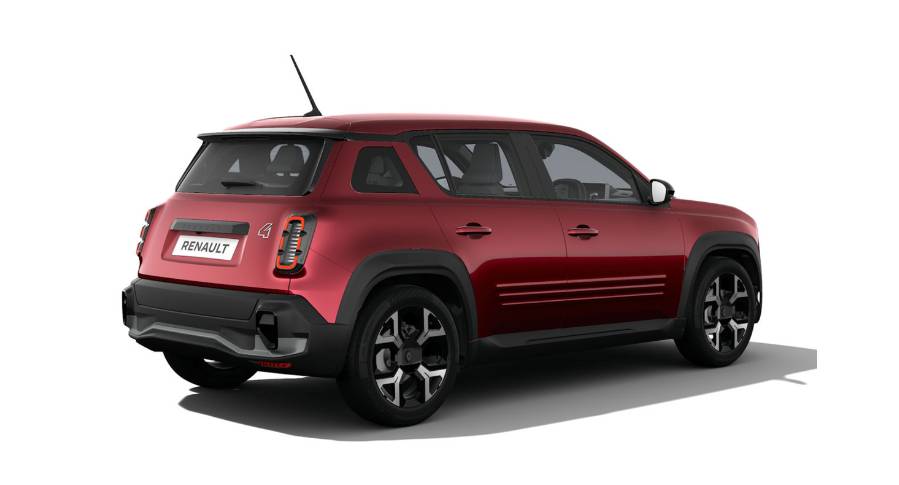
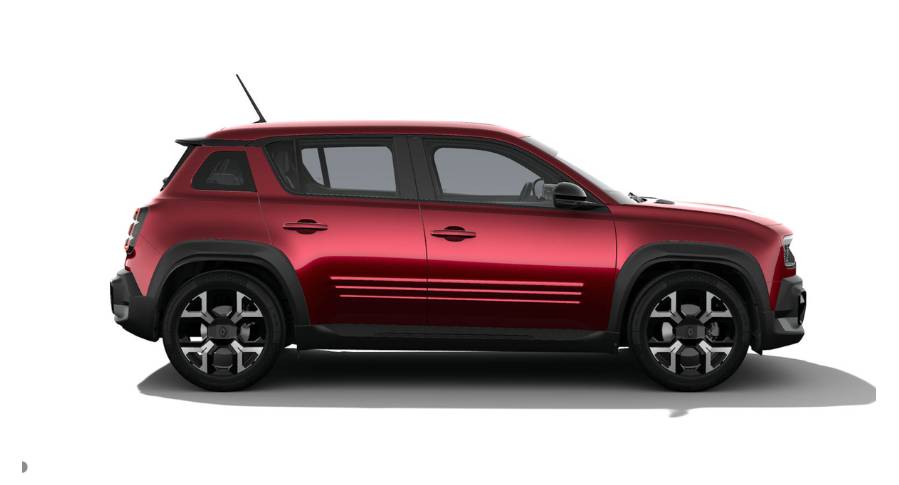
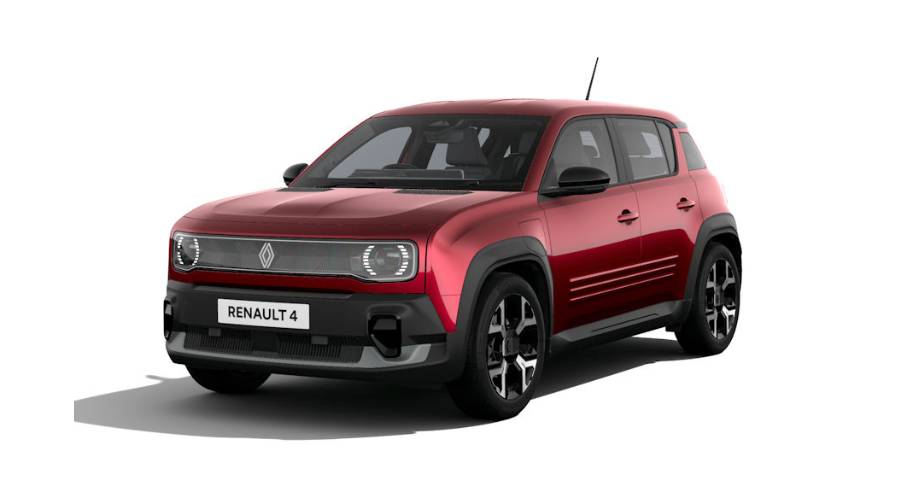
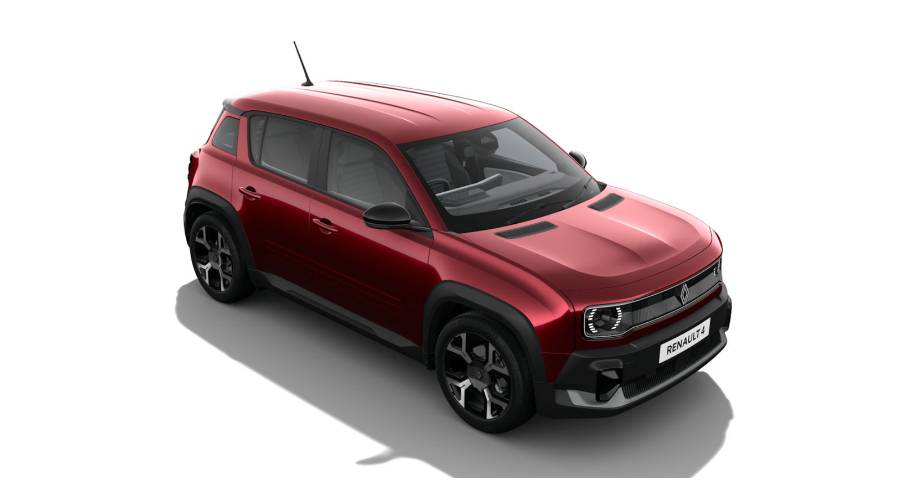
The All-Electric Renault 4 E-Tech SUV (credit: Renault)
| At A Glance | |
|---|---|
| EV Type: | Battery-Electric Vehicle (BEV) |
| Vehicle Type: | SUV |
| Engine: | Electric |
| Available In India: | No |
| Trims (2 Options) |
|---|
| Renault 4 E-Tech 40 kWh (from ₹ N/A) |
| Renault 4 E-Tech 52 kWh (from ₹ N/A) |
| EV Battery & Emissions | |
|---|---|
| EV Battery Type: | Lithium-ion |
| EV Battery Capacity: | Available in two battery sizes: 40 kWh (237 kg / 400V)/ 52 kWh (297 kg / 400V) |
| Charging: | 100 kW DC Rapid Charging (15%-80%: 30 mins). Onboard AC charger: 11 kW AC (15%-80%: 2 hrs 37 mins/ 3 hrs 13 mins)/ 7.4 kW AC (15%-80%: 3 hrs 55 mins/ 5 hrs 11 mins) |
| Charge Port: | Type 2 |
| EV Cable Type: | Type 2 |
| Tailpipe Emissions: | 0g (CO2/km) |
| EV Battery Warranty: | 8 years or 160,000 km |
| Charging Times (Overview) | |
|---|---|
| Slow charging AC (3 kW – 3.6 kW): | 6 – 12 hours (dependent on size of EV battery & SOC) |
| Fast charging AC (7 kW – 22 kW): | 3 – 8 hours (dependent on size of EV battery & SoC) |
| Rapid charging AC (43 kW): | 0-80%: 20 mins to 60 mins (dependent on size of EV battery & SoC) |
| Rapid charging DC (50 kW+): | 0-80%: 20 mins to 60 mins (dependent on size of EV battery & SoC) |
| Ultra rapid charging DC (150 kW+): | 0-80% : 20 mins to 40 mins (dependent on size of EV battery & SoC) |
| Tesla Supercharger (120 kW – 250 kW): | 0-80%: up to 25 mins (dependent on size of EV battery & SoC) |
- Note 1: SoC: state of charge
| Dimensions | |
|---|---|
| Height (mm): | 1552 – 1572 |
| Width (mm): | 1796 |
| Length (mm): | 4143 |
| Wheelbase (mm): | 2624 |
| Turning Circle (m): | 10.8 |
| Boot Space (L): | 420 (rear seats folded down: 1,405 L) |
| Frunk (L): | N/A |
| EV40 120hp | |
|---|---|
| EV Battery Capacity: | 40 kWh |
| Pure Electric Range (WLTP): | 308 km |
| Electric Energy Consumption (kWh/ 100km): | 14.7 |
| Km per kWh: | 7.7 |
| Charging: | 100 kW DC Rapid Charging (15%-80%: 30 mins). Onboard AC charger: 11 kW AC (15%-80%: 2 hrs 37 mins)/ 7.4 kW AC (15%-80%: 3 hrs 55 mins) |
| Top Speed: | 150 km/h |
| 0-100 km/h: | 9.2 seconds |
| Drive: | Front-wheel drive (FWD) |
| Electric Motor (kW): | 90 |
| Max Power (hp): | 120 |
| Torque (Nm): | 225 |
| Transmission: | Automatic |
| Seats: | 5 |
| Doors: | 5 |
| Gross Weight (kg): | 1,462/1,521 |
| Towing Capacity (Braked/Unbraked)/ (kg): | 750/ 750 |
| Colours: | 6 |
| Euro NCAP Safety Rating: | 4/5 |
| Insurance: | N/A |
| EV52 150hp | |
|---|---|
| EV Battery Capacity: | 52 kWh |
| Pure Electric Range (WLTP): | 409 km |
| Electric Energy Consumption (kWh/ 100km): | 15.6 – 15.9 |
| Km per kWh: | 7.86 |
| Charging: | 100 kW DC Rapid Charging (15%-80%: 30 mins). Onboard AC charger: 11 kW AC (15%-80%: 3 hrs 13 mins)/ 7.4 kW AC (15%-80%: 5 hrs 11 mins) |
| Top Speed: | 150 km/h |
| 0-100 km/h: | 8.2 seconds |
| Drive: | Front-wheel drive (FWD) |
| Electric Motor (kW): | 110 |
| Max Power (hp): | 150 |
| Torque (Nm): | 245 |
| Transmission: | Automatic |
| Seats: | 5 |
| Doors: | 5 |
| Gross Weight (kg): | 1,462/1,521 |
| Towing Capacity (Braked/Unbraked)/ (kg): | 750/ 750 |
| Colours: | 6 |
| Euro NCAP Safety Rating: | 4/5 |
| Insurance: | N/A |
Electric Driving: Top 5 EV Jargons For India
Despite the increased visibility of EVs in India, the vocabulary (jargon) used in electric driving is still new to consumers. In fact, for many, it can seem daunting and confusing. We have therefore put below some of the more commonly used terms in the EV glossary, to give you an easier introduction to electric driving in India!
| EV Glossary: Top 5 | |
|---|---|
| DoD (Depth-Of-Charge): | What is Depth-Of-Charge? A battery’s Depth-of-Charge is the level of discharge of a battery. As you drive an EV, the battery is discharged. The DoD indicates the % that has been discharged relative to the capacity of a battery. Conversely, a State-of-Charge (SOC), is the percentage of capacity still available in a battery. If you use 25% of your EV battery capacity, then the DoD is 25% and the SOC is 75%. It is recommended not to fully discharge an electric car battery, as this reduces the lifespan of a battery. Automotive manufacturers publish recommend DoD levels for charging, but a charging range between 20% to 80% is ideal. |
| EV Battery Life: | What is the life of an EV battery? Like petrol and diesel engines, electric car batteries also have a finite lifespan. Though EV battery technology has come a long way over the past few years, battery degradation is inevitable. Just as normal wear and tear is the case for an internal combustion engine (ICE) vehicle. Currently most EV manufacturers are offering a warranty up to 8 years or 160,000 km. However, some automotive manufacturers are offering an even longer EV battery warranty. An example is the Japanese automotive manufacturer, Toyota. The company offers a 10 years EV battery warranty for the all-electric Toyota bZ4X SUV. In most cases, such warranties are up to 70% of the original EV battery capacity. The battery life is impacted by a number of factors, which in turn impacts battery electrical performance, to include, the range the electric car can travel. The most commonly used batteries in electric cars are lithium-ion batteries. |
| Frunk: | What is a frunk? Though a frunk is not a new term, its availability is becoming more widespread with the development of electric vehicles (EVs). A frunk is a storage space/ compartment/ trunk in the front of a vehicle, rather than the rear. In the case of pure electric cars, given that these vehicles do not have an onboard internal combustion engine (ICE), there is space for a frunk. It is worth noting that a frunk is usually much smaller than a trunk, and in EVs, a good space for storing the EV cable. |
| One-Pedal Driving: | What is one-pedal driving? In one-pedal driving, the EV slows down or stops, when the pedal is released. One-pedal functionality reduce the need to use the brake pedal, for speed reduction or stopping. Of course, the brake pedal is still the best way to hold a vehicle in place at a complete stop. |
| WLTP (Worldwide Harmonised Light Vehicle Test Procedure): | In a bid to continue to improve the quality of realistic data released by automotive manufacturers, on economy, range and CO2 emissions, Europe has implemented its first phase for the WLTP program. The testing procedures under WLTP will result in reduced ranges for electric cars released under other previous testing regimes. The WLTP is seen as a significant improvement over the New European Driving Cycle (NEDC) designed in the 1980s and based on theoretical driving. The WLTP has been developed with the aim of becoming a global standard, so that cars can be easily compared between regions. |
While e-zoomed uses reasonable efforts to provide accurate and up-to-date information, some of the information provided is gathered from third parties and has not been independently verified by e-zoomed. While the information from the third party sources is believed to be reliable, no warranty, express or implied, is made by e-zoomed regarding the accuracy, adequacy, completeness, legality, reliability or usefulness of any information. This disclaimer applies to both isolated and aggregate uses of this information.
Related articles

The All-Electric Volvo EX30 (SUV): The Complete Electric Car Buying Guide For India
Electric Cars: The Basics For those of you new to zero-emission electric driving, we recommend a read of the following articles: Sign up to the newsletter The All-Electric Renault…
Read More
The Fiat 600e Electric (SUV): The Complete Electric Car Buying Guide For India
Electric Cars: The Basics For those of you new to zero-emission electric driving, we recommend a read of the following articles: Sign up to the newsletter The All-Electric Renault…
Read More
The All-Electric Smart #3 (SUV-Coupé): The Complete Electric Car Buying Guide For India
Electric Cars: The Basics For those of you new to zero-emission electric driving, we recommend a read of the following articles: Sign up to the newsletter The All-Electric Renault…
Read More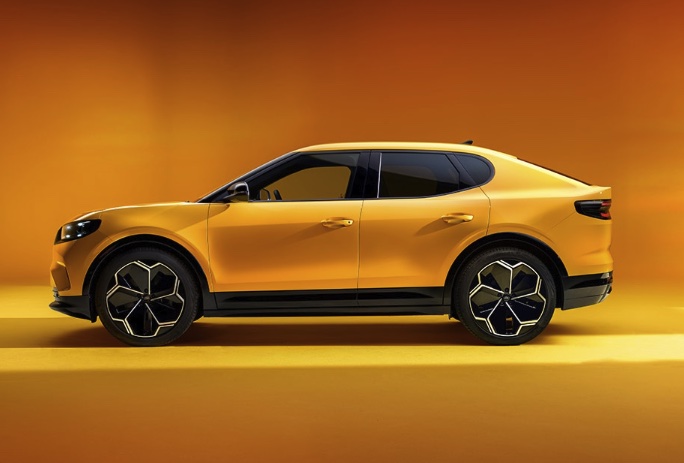
The Ford Capri Electric (SUV): The Complete Electric Car Buying Guide For India
Electric Cars: The Basics For those of you new to zero-emission electric driving, we recommend a read of the following articles: Sign up to the newsletter The All-Electric Renault…
Read More
The BYD Sealion 7 Electric (SUV): The Complete Electric Car Buying Guide For India
Electric Cars: The Basics For those of you new to zero-emission electric driving, we recommend a read of the following articles: Sign up to the newsletter The All-Electric Renault…
Read More