Electric Cars: The Basics
For those of you new to zero-emission electric driving, we recommend a read of the following articles:
What Is Regenerative Braking In Electric Cars: The Basics: The Complete Electric Car Buying Guide For India
Electric Cars: The Basics For those of you new to zero-emission electric driving, we recommend a read of the following articles: Sign up to the newsletter The All-Electric Renault…
Read More
The History Of Electric Cars and Vehicles: Are EVs A New Invention?
Electric Cars: The Basics For those of you new to zero-emission electric driving, we recommend a read of the following articles: Sign up to the newsletter The All-Electric Renault…
Read More
Different Types Of Electric Cars: The Complete Electric Car Buying Guide For India
Electric Cars: The Basics For those of you new to zero-emission electric driving, we recommend a read of the following articles: Sign up to the newsletter The All-Electric Renault…
Read More
Electric Cars and Vehicles: Pros, Cons And Myths: The Complete Electric Car Buying Guide For India
Electric Cars: The Basics For those of you new to zero-emission electric driving, we recommend a read of the following articles: Sign up to the newsletter The All-Electric Renault…
Read More
Electric Cars Range: WLTP: The Basics: The Complete Electric Car Buying Guide For India
Electric Cars: The Basics For those of you new to zero-emission electric driving, we recommend a read of the following articles: Sign up to the newsletter The All-Electric Renault…
Read MoreSign up to the newsletter
The All-Electric Renault Scenic E-Tech SUV
Groupe Renault (Renault Group/ Renault S.A.), is a leading player in the global automotive sector. The company was established in 1899 and has over the course of its history, manufactured varied vehicles, to include: trucks, tractors, buses and even tanks! Renault has been part of the global Renault-Nissan-Mitsubishi Alliance since 1999 (previously, Renault-Nissan Alliance). The partnership makes the partnership the 3rd largest automotive group in the world after Volkswagen and Toyota. Renault offers both, battery-electric vehicles (BEVs), and plug-in hybrid electric vehicles (PHEVs) for passenger cars and commercial electric vehicles. The portfolio includes:
- All-electric Renault TWIZY (BEV)
- All-electric Renault ZOE E-TECH (BEV)
- All-electric Renault ZOE Van E-TECH (BEV)
- All-electric Renault Megane E-TECH (BEV)
- All-electric Renault Scenic E-TECH (BEV)
- All-electric Renault 4 E-TECH (BEV)
- All-electric Renault 5 E-TECH (BEV)
- All-electric Renault Kangoo E-TECH (BEV)
- All-electric Renault Master E-TECH (BEV)
- Renault Rafale E-Tech Plug-In Hybrid (PHEV)
- Renault Captur E-TECH Plug-In Hybrid (PHEV)
- Renault Megane E-TECH Plug-In Hybrid (PHEV)
- Renault Megane Sport Tourer E-TECH Plug-In Hybrid (PHEV)
The all-electric Renault Scenic compact SUV has certainly made a statement since the production version was released in September 2023. Since then, the Scenic E-Tech 100% electric car has won number of accolades and positive reviews, to include, The Car of the Year 2024 and AutoTrader New Car Awards 2024. The pure electric Scenic demonstrates how far Renault has progressed in relation to the development of electric vehicles (EVs), since the launch of the all-electric Renault Zoe in 2012.
The conventional internal combustion engine Renault Scénic, a compact multi-purpose vehicle (MPV) was launched in 1996. However, given the global trend towards SUVs, in particular, compact e-SUVs, it is not surprising the Scénic has been transformed to an all-electric SUV. The concept Renault Scenic Vision was shown in May 2022 developed on the Common Module Family (CMF-EV) platform.
The platform, a Renault-Nissan-Mitsubishi alliance initiative was renamed AmpR Medium in November 2023. The all-electric Nissan Ariya and the Renault Megane E-Tech Electric also use this platform. The compact pure electric five-door Scenic E-Tech SUV is 4.47m long (wheelbase: 2.78m), with a 1.57m height. In comparison, the Nissan Ariya is 4.59m long (wheelbase: 2.77m), with a 1.66m height.
The Scenic 100% electric family car is available in two EV battery sizes (400V Lithium-ion): 60 kWh (Comfort Range)/ 87 kWh (Long Range). The smaller 60 kWh EV battery has a 430 km claimed WLTP range, while the 87 kWh has a 625 km claimed range (WLTP). The Scenic EV has a certified consumption between 16.3 and 17.2 (kWh/ 100km). Adjusting for real-world driving conditions, expect the entry-level 60 kWh to achieve up to 365 km, and the larger 87 kWh to achieve 530 km on a full charge. A heat pump comes as standard. A heat pump increases the efficiency of the EV i.e. increases the zero-tailpipe emission electric range.
Though, it maybe tempting to opt for the Long Range variant, we encourage buyers to deliberate carefully if they really need the larger EV battery. Most families use a vehicle for short commutes (school runs, grocery store, gym etc). The 60 kWh EV battery is adequate for most day-to-day driving needs. However, if you are intending to travel long distances on a regular basis, then the 87 kWh variant may be more suited.
The pure electric Scenic offers AC charging capability up to 22 kW (three-phase). For homes powered by single-phase power supply, the charging will be limited to 7.4 kW. The 60 kWh EV battery can be fully charged (0%-100%) in 9 hours 15 minutes using a single-phase smart EV charger. Charging at 11 kW (three-phase) will take 6 hours 30 minutes, and at 22 kW (three-phase), 3 hours 15 minutes. DC charging at 150 kW, the EV battery can be charged from 15%-80% in 32 minutes.
The 87 kWh EV battery can be fully charged (0%-100%) in 12 hours 56 minutes using a single-phase smart EV charger. Charging at 11 kW (three-phase) will take 9 hours and at 22 kW (three-phase), 4 hours 48 minutes. DC charging at 150 kW, the EV battery can be charged from 15%-80% in 37 minutes. For those new to electric cars, we at e-zoomed encourage the use of on-site solar PV and battery storage for home charging. It helps save money and also achieve ‘well-to-wheel’ zero-tailpipe emissions for the electric car. Battery storage can be used for powering both the EV and your home.
The manufacturer offers a good level of equipment and technology as standard, to include: autonomous driving level 1: adaptive cruise control with speed limiter, active driver assist: adaptive cruise control + lane keeping assist, hill start assist, emergency lane keep assist including solid line, oncoming traffic & road edge detection, blind spot recognition & rear detection with emergency lane keeping assist, lane departure warning, lane change warning, lane keeping assist, rear view camera and more. The EV has not yet been awarded the Euro NCAP Safety Rating.
Also as standard are: 12″ openR multimedia screen, 12.3″ driver information display and wireless phone charger. However, features like the solarbay panoramic sunroof, smart rear view mirror, 360 camera, hands free parking are only available with the top trim! In terms of practicality, the EV does not have a frunk, but does offer a decent sized glove box. There is also decent headroom and legroom for passengers seated in the rear, and the panoramic sunroof does enhance the sense of space. The BEV has a 545 L boot. The exterior styling is a good balance between a conventional and modern design. We think it is very appealing.
The five-seat five-door Renault Scenic electric SUV is available only as a front-wheel drive (FWD). The E-Tech electric 170 hp (comfort range/ 60 kWh) variant can achieve 0-100 km/h in 8.6 seconds (max power: 170 hp/ Torque: 280 Nm). The top speed of the EV is 150 km/h. The E-Tech electric 220 hp (long range/ 87 kWh) variant can achieve 0-100 km/h in 7.9 seconds (max power: 220 hp/ Torque: 300 Nm). The top speed of the EV is 170 km/h. Do keep in mind the weight of the onboard EV battery does impact performance. The 60 kWh battery weighs 411 kg, while the 87 kWh weighs 530 kg.
Bottom-line, electric driving is good for the environment and the wallet!
| PROS | CONS |
|---|---|
| Available in two EV battery sizes with good range | DC charging limited to 150 kW DC |
| AC charging up to 22 kW/ heat pump as standard | Solarbay panoramic sunroof not standard on all variants |
| Spacious and practical | Rear-view limited visibility |
Gallery
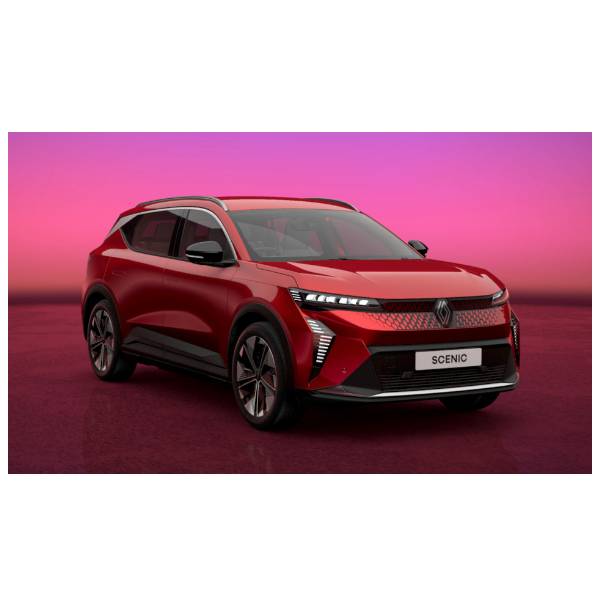
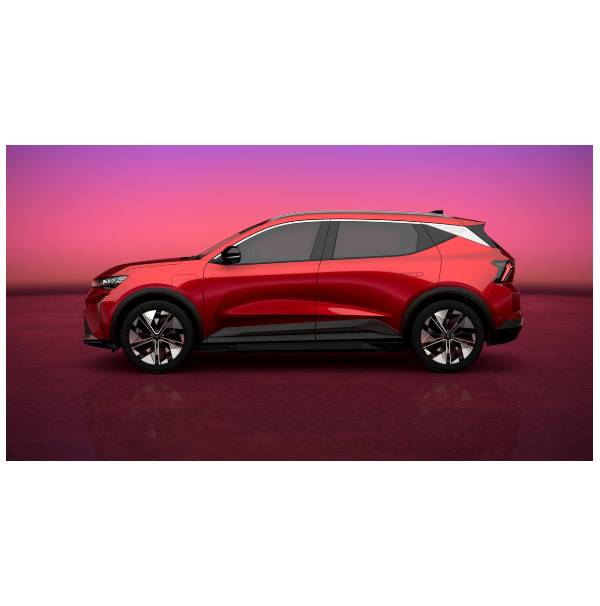
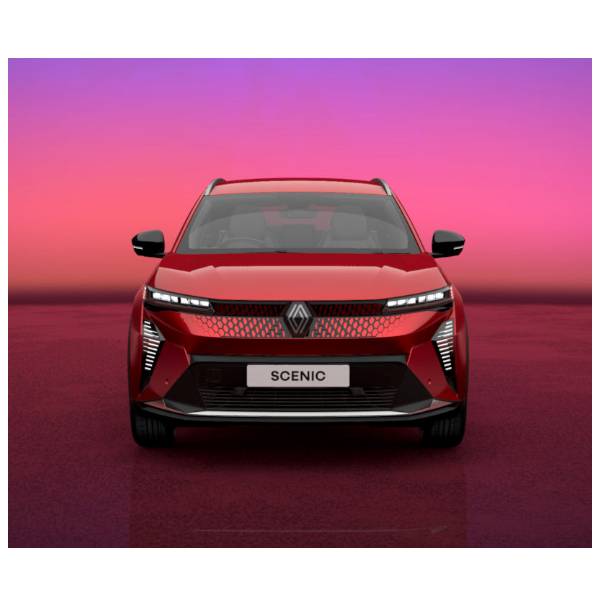
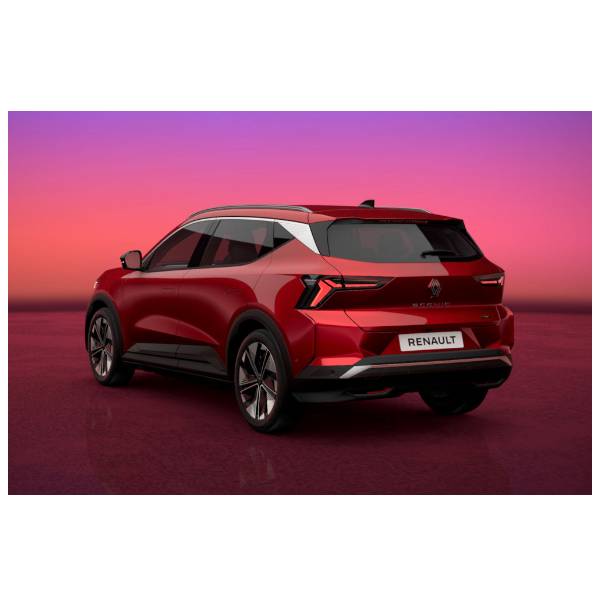
The All-Electric Renault Scenic E-Tech SUV (credit: Renault)
| At A Glance | |
|---|---|
| EV Type: | Battery-Electric Vehicle (BEV) |
| Vehicle Type: | SUV |
| Engine: | Electric |
| Available In India: | No |
| Trims (1 Option) |
|---|
| Renault Scenic E-Tech (from ₹ N/A) |
| EV Battery & Emissions | |
|---|---|
| EV Battery Type: | Lithium-ion |
| EV Battery Capacity: | Available in two battery sizes: 60 kWh (411 kg)/ 87 kWh (530 kg) |
| Charging: | 130 – 150 kW DC Rapid Charging (15%-80%: 32-37 mins). Onboard AC charger: 22 kW AC (0%-100%: 3 hrs 15 mins/ 4 hrs 48 mins) |
| Charge Port: | Type 2 |
| EV Cable Type: | Type 2 |
| Tailpipe Emissions: | 0g (CO2/km) |
| EV Battery Warranty: | 8 years or 160,000 km |
| Charging Times (Overview) | |
|---|---|
| Slow charging AC (3 kW – 3.6 kW): | 6 – 12 hours (dependent on size of EV battery & SOC) |
| Fast charging AC (7 kW – 22 kW): | 3 – 8 hours (dependent on size of EV battery & SoC) |
| Rapid charging AC (43 kW): | 0-80%: 20 mins to 60 mins (dependent on size of EV battery & SoC) |
| Rapid charging DC (50 kW+): | 0-80%: 20 mins to 60 mins (dependent on size of EV battery & SoC) |
| Ultra rapid charging DC (150 kW+): | 0-80% : 20 mins to 40 mins (dependent on size of EV battery & SoC) |
| Tesla Supercharger (120 kW – 250 kW): | 0-80%: up to 25 mins (dependent on size of EV battery & SoC) |
- Note 1: SoC: state of charge
| Dimensions | |
|---|---|
| Height (mm): | 1571 |
| Width (mm): | 1864 |
| Length (mm): | 4470 |
| Wheelbase (mm): | 2785 |
| Turning Circle (m): | 10.92 |
| Boot Space (L): | 545 |
| Frunk (L): | N/A |
| E-Tech electric 170 hp (comfort range) | |
|---|---|
| EV Battery Capacity: | 60 kWh |
| Pure Electric Range (WLTP): | 430 km |
| Electric Energy Consumption (kWh/ 100km): | 16.3 – 16.7 |
| Charging: | 130 kW DC Rapid Charging (15%-80%: 32 mins). Onboard AC charger: 22 kW AC (0%-100%: 3 hrs 15 mins)/ 7.4 kW AC (0%-100%: 9 hrs 15 mins |
| Top Speed: | 150 km/h |
| 0-100 km/h: | 8.6 seconds |
| Drive: | Front-wheel drive (FWD) |
| Electric Motor (kW): | 125 |
| Max Power (hp): | 170 |
| Torque (Nm): | 280 |
| Transmission: | Automatic |
| Seats: | 5 |
| Doors: | 5 |
| Kerb Weight (kg): | 1,757 |
| Towing Capacity (Braked/Unbraked)/ (kg): | 1,100/ 750 |
| Colours: | 9 |
| Euro NCAP Safety Rating: | N/A |
| E-Tech electric 220 hp (long range) | |
|---|---|
| EV Battery Capacity: | 87 kWh |
| Pure Electric Range (WLTP): | 625 km |
| Electric Energy Consumption (kWh/ 100km): | 17.2 |
| Charging: | 150 kW DC Rapid Charging (15%-80%: 37 mins). Onboard AC charger: 22 kW AC (0%-100%: 4 hrs 48 mins)/ 7.4 kW AC (0%-100%: 12 hrs 56 mins) |
| Top Speed: | 170 km/h |
| 0-100 km/h: | 7.9 seconds |
| Drive: | Front-wheel drive (FWD) |
| Electric Motor (kW): | 160 |
| Max Power (hp): | 220 |
| Torque (Nm): | 300 |
| Transmission: | Automatic |
| Seats: | 5 |
| Doors: | 5 |
| Kerb Weight (kg): | 1,853 |
| Towing Capacity (Braked/Unbraked)/ (kg): | 1,100/ 750 |
| Colours: | 9 |
| Euro NCAP Safety Rating: | N/A |
Electric Vehicles (EVs): Top Jargons
Despite the increased visibility of EVs in India, the vocabulary (jargon) used in electric driving is still new to consumers. In fact, for many, it can seem daunting and confusing. We have therefore put below some of the more commonly used terms in the EV glossary, to give you an easier introduction to electric driving in India!
| Glossary: Electric Vehicles (EVs) | |
|---|---|
| Battery-Electric Vehicle (BEV): | What is a BEV? A battery-electric vehicle (BEV) is more commonly referred to as a pure electric car. A BEV is ‘pure’, in that, the vehicle only uses electric power for propulsion i.e. a BEV does not have an internal combustion engine (ICE). It is easy to recognise these zero-tailpipe emission green cars, as these vehicles are silent (except for the artificial noise), and do not have a tailpipe! |
| Frunk: | What is a frunk? Though a frunk is not a new term, its availability is becoming more widespread with the development of electric vehicles (EVs). A frunk is a storage space/ compartment/ trunk in the front of a vehicle, rather than the rear. In the case of pure electric cars, given that these vehicles do not have an onboard internal combustion engine (ICE), there is space for a frunk. It is worth noting that a frunk is usually much smaller than a trunk, and in EVs, a good space for storing the EV cable. |
| Mild Hybrid Electric Vehicles (MHEVs): | What is a MHEV? Mild hybrids use both an internal combustion engine (ICE) and an electric motor. These cars are also known as ‘self-charging hybrids’. The vehicle uses regenerative braking (recuperated electric energy) to improve the fuel efficiency and to reduce tailpipe emissions (CO2 g/km). However, mild hybrids cannot be charged by an external power source, like an EV charger. |
| Plug-In Hybrid Electric Vehicle (PHEV): | What is a PHEV? Like a MHEV, a plug-in hybrid electric vehicle (PHEV) aims to increase the fuel efficiency and reduce tailpipe emissions. However there is much difference between a PHEV and a MHEV. A PHEV has a more powerful electric motor and a larger onboard EV battery. In a PHEV, the electric motor and onboard EV battery are also used to propel the electric vehicle. Moreover, a PHEV battery is charged by using an external power source, like a dedicated EV charger. |
| Regenerative Braking: | What is regenerative braking? Also known as regen braking or brake recuperation, regenerative braking is a process of capturing the wasted energy (during braking) from an electric vehicle, to be reused (recycled). In the case of electric driving, the ‘captured’ energy is reused to increase the pure electric range of the EV. |
While e-zoomed uses reasonable efforts to provide accurate and up-to-date information, some of the information provided is gathered from third parties and has not been independently verified by e-zoomed. While the information from the third party sources is believed to be reliable, no warranty, express or implied, is made by e-zoomed regarding the accuracy, adequacy, completeness, legality, reliability or usefulness of any information. This disclaimer applies to both isolated and aggregate uses of this information.
Related articles

The All-Electric Lexus RZ 450e (SUV): The Complete Electric Car Buying Guide For India
Electric Cars: The Basics For those of you new to zero-emission electric driving, we recommend a read of the following articles: Sign up to the newsletter The All-Electric Renault…
Read More
The BMW iX2 Electric (SUV): The Complete Electric Car Buying Guide For India
Electric Cars: The Basics For those of you new to zero-emission electric driving, we recommend a read of the following articles: Sign up to the newsletter The All-Electric Renault…
Read More
The All-Electric Volvo EX30 (SUV): The Complete Electric Car Buying Guide For India
Electric Cars: The Basics For those of you new to zero-emission electric driving, we recommend a read of the following articles: Sign up to the newsletter The All-Electric Renault…
Read More
The Fiat 600e Electric (SUV): The Complete Electric Car Buying Guide For India
Electric Cars: The Basics For those of you new to zero-emission electric driving, we recommend a read of the following articles: Sign up to the newsletter The All-Electric Renault…
Read More
The All-Electric Kia EV9 (SUV): The Complete Electric Car Buying Guide For India
Electric Cars: The Basics For those of you new to zero-emission electric driving, we recommend a read of the following articles: Sign up to the newsletter The All-Electric Renault…
Read More