

Electric Cars: The Basics
For those of you new to zero-emission electric driving, we recommend a read of the following articles:
What Is Regenerative Braking In Electric Cars: The Basics: The Complete Electric Car Buying Guide For India
Electric Cars: The Basics For those of you new to zero-emission electric driving, we recommend a read of the following articles: Sign up to the newsletter The Renault Megane…
Read More
The History Of Electric Cars and Vehicles: Are EVs A New Invention?
Electric Cars: The Basics For those of you new to zero-emission electric driving, we recommend a read of the following articles: Sign up to the newsletter The Renault Megane…
Read More
Different Types Of Electric Cars: The Complete Electric Car Buying Guide For India
Electric Cars: The Basics For those of you new to zero-emission electric driving, we recommend a read of the following articles: Sign up to the newsletter The Renault Megane…
Read More
Electric Cars and Vehicles: Pros, Cons And Myths: The Complete Electric Car Buying Guide For India
Electric Cars: The Basics For those of you new to zero-emission electric driving, we recommend a read of the following articles: Sign up to the newsletter The Renault Megane…
Read More
Electric Cars Range: WLTP: The Basics: The Complete Electric Car Buying Guide For India
Electric Cars: The Basics For those of you new to zero-emission electric driving, we recommend a read of the following articles: Sign up to the newsletter The Renault Megane…
Read MoreSign up to the newsletter
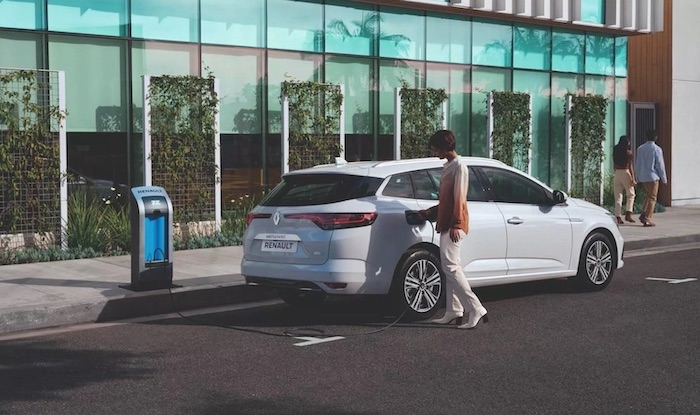
The Renault Megane Sport Tourer PHEV Estate
Groupe Renault (Renault Group/ Renault S.A.), is a leading player in the global automotive sector. The company was established in 1899 and has over the course of its history, manufactured varied vehicles, to include: trucks, tractors, buses and even tanks! Renault has been part of the global Renault-Nissan-Mitsubishi Alliance since 1999 (previously, Renault-Nissan Alliance). The partnership makes the partnership the 3rd largest automotive group in the world after Volkswagen and Toyota. Renault offers both, battery-electric vehicles (BEVs), and plug-in hybrid electric vehicles (PHEVs) for passenger cars and commercial electric vehicles. The portfolio includes:
- All-electric Renault TWIZY (BEV)
- All-electric Renault ZOE E-TECH (BEV)
- All-electric Renault ZOE Van E-TECH (BEV)
- All-electric Renault Megane E-TECH (BEV)
- All-electric Renault Scenic E-TECH (BEV)
- All-electric Renault 4 E-TECH (BEV)
- All-electric Renault 5 E-TECH (BEV)
- All-electric Renault Kangoo E-TECH (BEV)
- All-electric Renault Master E-TECH (BEV)
- Renault Rafale E-Tech Plug-In Hybrid (PHEV)
- Renault Captur E-TECH Plug-In Hybrid (PHEV)
- Renault Megane E-TECH Plug-In Hybrid (PHEV)
- Renault Megane Sport Tourer E-TECH Plug-In Hybrid (PHEV)
The Renault Megane family car has been available since 1996. The concept version was unveiled in 2011. The vehicle is now in its fourth generation, which was unveiled in 2015. The Megane received a facelift in 2020, which also included the introduction of the Megane plug-in hybrid electric vehicle (PHEV).
Looking for a spacious family car, with an affordable price tag and low running costs? Well, the Megane Sport Tourer (estate) plug-in electric car is certainly an option worth considering. Despite the increased availability of family electric cars over the past three years, the introduction of estate electric cars has been relatively limited, for both the premium and non-premium badges.
Estate electric vehicles, like the Megane Sport Tourer PHEV have much to offer families and company car drivers aspiring to migrate to emission-free electric driving. We encourage automotive manufacturers to demonstrate more commitment for launching estate electric cars.
Though the Megane electric car EV battery size is limited to 9.8 kWh, the EV is able to deliver a fuel-free zero-tailpipe emission range up to 48 km (WLTP). Of course, do keep in mind that the real-world EV range will be lower than the claimed WLTP range, and assuming a 40 km electric range is more realistic. However, ample range to take advantage of the lower cost of driving an electric car.
Also, the best way to enjoy the smoother and silent electric mode, is to make sure that the EV battery is ‘topped-up’ on a regular basis. This also helps with the long-term health and maintenance of the EV battery. The EV has a 3.6 kW onboard charger and is not capable of DC charging. This is quite typical of PHEVs, however, many plug-in electric cars offer a 7.4 kW onboard charger and are capable of rapid charging. The EV can be fully charged in 3 hours.
Like all PHEVs, the pairing of an electric motor with the internal combustion engine (ICE), also helps reduce the tailpipe-emissions for the plug-in electric car. The claimed tailpipe-emissions is up to 30g (CO2/km). The lower the emissions, the lower the local air pollution. A win-win for all!
The hybrid drivetrain also improves the overall efficiency of the electric vehicle (EV). Renault claims a fuel economy up to 1.3 l/100km. Of course, real-world fuel economy will be impacted by a number of factors, to include, the use of the e-mode i.e. the more the EV is driven on electric mode, the better the fuel economy.
The performance of the electric estate will not set the heart racing, but it does the job! The front-wheel drive Renault plug-in hybrid can achieve 0-100 km/h in 9.8 seconds, with a top speed of 183 km/h. The hybrid drivetrain delivers a maximum power of 160 HP (torque: 205 Nm), sufficient for city and motorway driving. Do keep in mind that the additional weight of the onboard EV battery does impact the overall performance of the vehicle (EV Kerb weight: 1,669 kg).
The EV does have a host of standard features and technology. However, the boot space has been impacted by the placement of the EV battery, nevertheless, the EV offers a cargo volume up to 394 L and an otherwise spacious interior. Bottom-line, electric driving is good for the environment and the wallet!
| PROS | CONS |
|---|---|
| Family friendly and a practical low emission estate car | Small EV battery (9.8 kWh) and limited range |
| Attractive exterior styling | Cabin interior not the most exciting |
| Good fuel efficiency and cheap to drive on electric mode | Some alternatives have a larger boot space |
Gallery
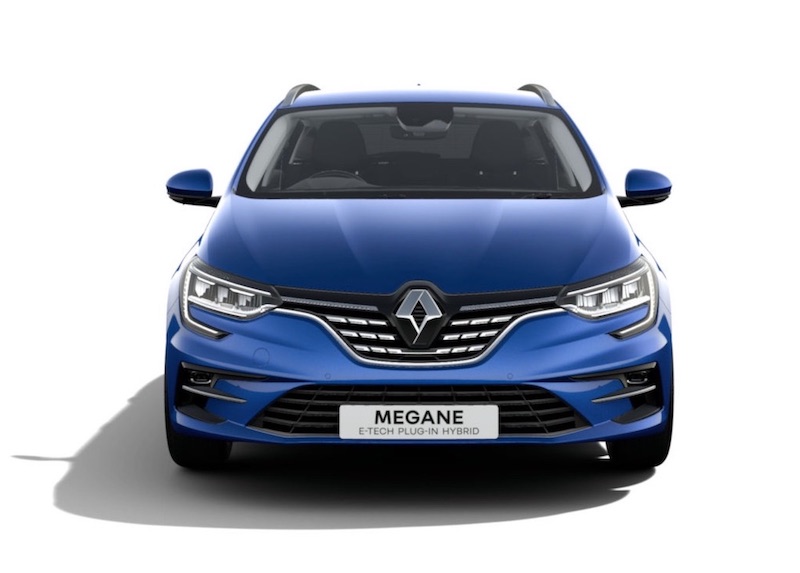


The Renault Megane Sport Tourer PHEV Estate (credit: Renault)
| At A Glance | |
|---|---|
| EV Type: | Plug-In Hybrid Electric Vehicle (PHEV) |
| Body Type: | Estate |
| Engines: | Petrol-Electric |
| Available In India: | No |
| Variants (1 Option) |
|---|
| Renault Megane Sport Tourer PHEV (Rs N/A) |
| EV Battery & Emissions | |
|---|---|
| EV Battery Type: | Lithium-ion |
| EV Battery Capacity: | Available in one battery size: 9.8 kWh |
| Charging: | On board charger: 3.6 kW AC |
| Charge Port: | Type 2 |
| EV Cable Type: | Type 2 |
| Tailpipe Emissions: | 30g (CO2/km) |
| Battery Warranty: | 8 years or 160,000 km |
| Charging Times (Overview) | |
|---|---|
| Slow charging AC (3 kW – 3.6 kW): | 6 – 12 hours (dependent on size of EV battery & SOC) |
| Fast charging AC (7 kW – 22 kW): | 3 – 8 hours (dependent on size of EV battery & SoC) |
| Rapid charging AC (43 kW): | 0-80%: 20 mins to 60 mins (dependent on size of EV battery & SoC) |
| Rapid charging DC (50 kW+): | 0-80%: 20 mins to 60 mins (dependent on size of EV battery & SoC) |
| Ultra rapid charging DC (150 kW+): | 0-80% : 20 mins to 40 mins (dependent on size of EV battery & SoC) |
| Tesla Supercharger (120 kW – 250 kW): | 0-80%: up to 25 mins (dependent on size of EV battery & SoC) |
- Note 1: SoC: state of charge
| Dimensions | |
|---|---|
| Height (mm): | 1448 |
| Width (mm): | 1814 |
| Length (mm): | 4626 |
| Wheelbase (mm): | 2712 |
| Turning Circle (m): | 11.4 |
| Boot capacity (L): | 394 |
| E-TECH Plug-In Hybrid 160 Auto | |
|---|---|
| EV Battery Capacity: | 9.8 kWh |
| Pure Electric Range (WLTP): | 48 km |
| Electric Energy Consumption (kWh/100km): | N/A |
| Fuel Consumption (l/100km): | 1.3 – 1.4 |
| Charging: | DC Charging not available. On board charger: 3.6 kW AC (0% – 100%: 3 hrs) |
| Top Speed: | 183 km/h |
| 0-100 km/h: | 9.8 seconds |
| Drive: | Front-wheel drive (FWD) |
| Electric Motor (kW): | N/A |
| Max Power (HP): | 160 |
| Torque (Nm): | 205 |
| Transmission: | Automatic |
| Seats: | 5 |
| Doors: | 5 |
| Kerb Weight (kg): | 1,669 |
| Colours: | 7 |
| NCAP Safety Rating: | Five-Star |
Electric Driving: Top 5 EV Jargons For India
Despite the increased visibility of EVs in India, the vocabulary (jargon) used in electric driving is still new to consumers. In fact, for many, it can seem daunting and confusing. We have therefore put below some of the more commonly used terms in the EV glossary, to give you an easier introduction to electric driving in India!
| EV Glossary: Top 5 | |
|---|---|
| Regenerative Braking: | Driving at all times requires braking. However, on more densely populated roads, the frequency and intensity of braking increases. Yes, it does result in longer journeys, but also reduces the efficiency of the vehicle. Regenerative braking is process of capturing energy otherwise wasted during braking. According to the rules of physics, energy cannot be destroyed, instead it simply transfers from one state to another. The same principle applies to braking. The kinetic energy that propels a car forward is usually displaced or wasted as heat. Regenerative braking captures this kinetic energy that in turns recharges an on board battery, increasing both efficiency and range. Cars like Toyota Prius, Jaguar I-PACE and Tesla Model 3 use regenerative braking. |
| What is Vehicle-to-Load (V2L) charging? | V2L charging is a bidirectional functionality allowing an electric vehicle (EV) to use its onboard high-voltage EV battery to charge or power devices/ appliances. It is also sometimes referred to as Vehicle-to-Device (V2D). Depending on the type of device/ appliance that needs to be charged or operated, V2L can be used while the EV is moving or parked. As an example, a laptop can be charged or used when an EV is parked or moving, while a lawn mower can only be charged or used when the EV is parked. V2L is a less complicated technology, compared to V2G, which requires interaction with the National Grid. V2L does not interact directly with the grid infrastructure. V2L cannot be used for powering your home or office. |
| What is Vehicle-to-Grid (V2G)? | V2G is an innovative bidirectional technology that allows the onboard EV battery to be charged and discharged i.e. electrical energy to be exported/ discharged from the onboard EV battery to the grid via a V2G compatible EV charger. It also allows for vital informational flow (data) to the grid. In effect, the V2G technology allows an EV battery to be used as a grid-connected energy storage unit. |
| One-Pedal Driving: | What is one-pedal driving? In one-pedal driving, the EV slows down or stops, when the pedal is released. One-pedal functionality reduce the need to use the brake pedal, for speed reduction or stopping. Of course, the brake pedal is still the best way to hold a vehicle in place at a complete stop. |
| WLTP (Worldwide Harmonised Light Vehicle Test Procedure): | In a bid to continue to improve the quality of realistic data released by automotive manufacturers, on economy, range and CO2 emissions, Europe has implemented its first phase for the WLTP program. The testing procedures under WLTP will result in reduced ranges for electric cars released under other previous testing regimes. The WLTP is seen as a significant improvement over the New European Driving Cycle (NEDC) designed in the 1980s and based on theoretical driving. The WLTP has been developed with the aim of becoming a global standard, so that cars can be easily compared between regions. |
While e-zoomed uses reasonable efforts to provide accurate and up-to-date information, some of the information provided is gathered from third parties and has not been independently verified by e-zoomed. While the information from the third party sources is believed to be reliable, no warranty, express or implied, is made by e-zoomed regarding the accuracy, adequacy, completeness, legality, reliability or usefulness of any information. This disclaimer applies to both isolated and aggregate uses of this information.
Related articles

The All-Electric MG5 EV (Estate): The Complete Electric Car Buying Guide For India
Electric Cars: The Basics For those of you new to zero-emission electric driving, we recommend a read of the following articles: Sign up to the newsletter The Renault Megane…
Read More
The Audi A6 Avant TFSIe Plug-In Hybrid (Estate): The Complete Electric Car Buying Guide For India
Electric Cars: The Basics For those of you new to zero-emission electric driving, we recommend a read of the following articles: Sign up to the newsletter The Renault Megane…
Read More
The Mercedes-Benz C Class Plug-In Hybrid (Estate): The Complete Electric Car Buying Guide For India
Electric Cars: The Basics For those of you new to zero-emission electric driving, we recommend a read of the following articles: Sign up to the newsletter The Renault Megane…
Read More
The Vauxhall Astra Sports Tourer Plug-In Hybrid (Estate): The Complete Electric Car Buying Guide For India
Electric Cars: The Basics For those of you new to zero-emission electric driving, we recommend a read of the following articles: Sign up to the newsletter The Renault Megane…
Read More
The Volkswagen ID.Buzz Electric (MPV): The Complete Electric Car Buying Guide For India
Electric Cars: The Basics For those of you new to zero-emission electric driving, we recommend a read of the following articles: Sign up to the newsletter The Renault Megane…
Read More